AI Model That Knows
When It Does Not Know
Uncertainty-Aware Decision Support and
Principled Escalation in High-Accountability Operations
by Bill SerGio
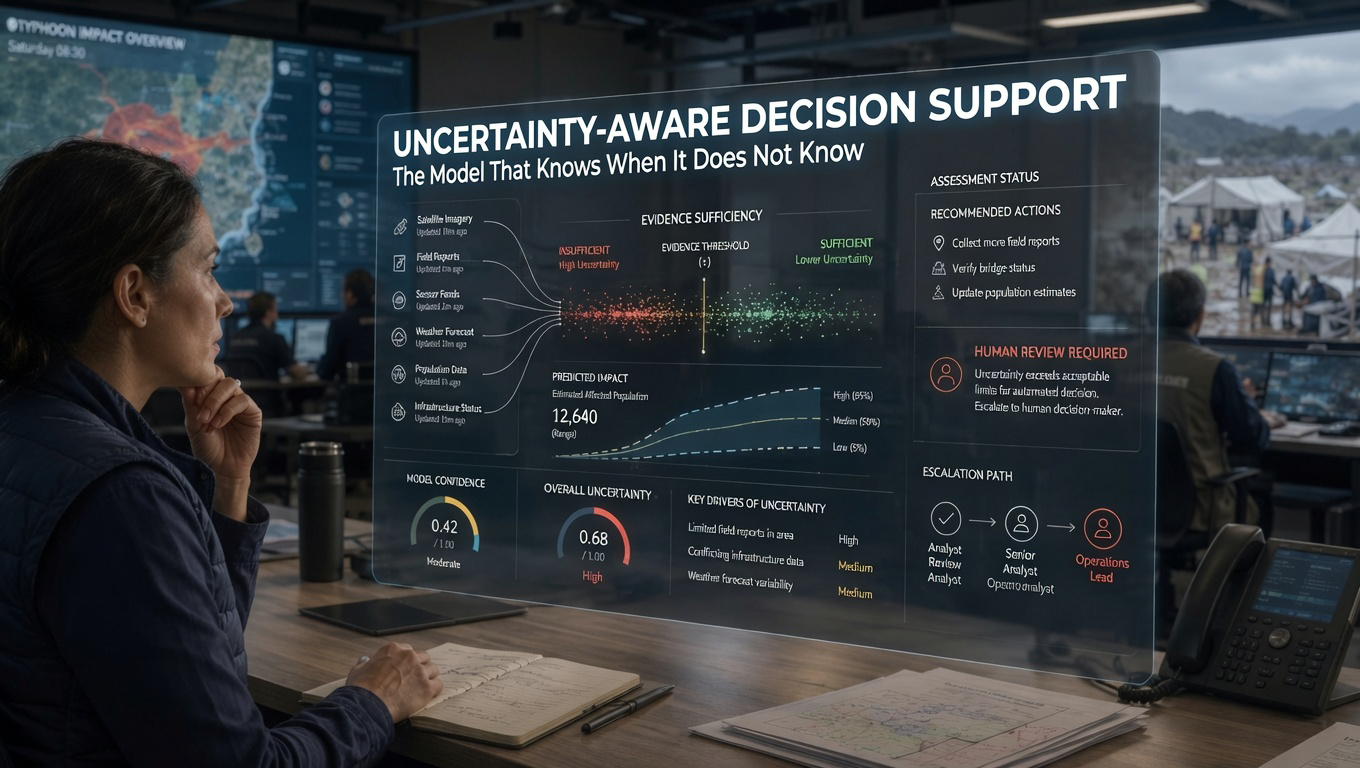
One of the most dangerous characteristics an AI system can have is not that it may occasionally be wrong.
It is that it may be wrong while sounding completely certain.
In high-accountability environments like disaster response, operational planning, safety-sensitive work, privacy-sensitive processes, or other mission-critical decisions—this matters profoundly.
A system may receive incomplete information, conflicting signals, delayed updates, unusual conditions, or inputs that fall outside its validated operating range.
In those moments, the responsible outcome is not always a confident recommendation.
Sometimes the best answer is:
“The available information is too uncertain. A qualified person must review this now.”
This article presents a conceptual framework for internally governed, uncertainty-aware decision support that can recognize when evidence is insufficient and escalate appropriately—while preserving qualified human authority over every consequential decision.
This is not a proposal to outsource decision-making, deploy unapproved third-party models, automate safety-critical decisions, monitor employees, inspect private content, or replace established Red Cross procedures. It is a concept for internally governed decision support, subject to Information Security, Privacy, Legal, Architecture, Accessibility, testing, source-code review, and business-owner governance.
Any future prototype would operate only within approved Red Cross technology environments, use only approved data sources, preserve privacy, and keep qualified people responsible for every consequential action.
Intelligence Includes Knowing the Limits of What Can Be Known
Many AI systems are designed to produce an answer whenever a question is asked.
That can be useful for lower-risk tasks such as drafting, summarization, research support, and organizing information.
In operational, safety, privacy, or mission-sensitive work, however, the more important question may be:
Is the available evidence sufficient to support a responsible recommendation?
A useful way to think about this is through uncertainty propagation.
Total uncertainty can be represented as:
U(total) = f[U(data), U(model), U(environment)]
Where:
- U(data) reflects uncertainty caused by incomplete, delayed, conflicting, missing, stale, or low-quality inputs.
- U(model) reflects uncertainty caused by limitations in the system’s structure, rule coverage, calibration, validated operating range, or decision logic.
- U(environment) reflects uncertainty caused by changing real-world conditions such as weather, demand surges, infrastructure disruption, communications failures, novel event types, or other volatility.
The exact relationship among these sources depends on whether they are independent, correlated, or driven by the same underlying event.
The central principle is simple:
Uncertainty should be surfaced rather than hidden.
When total uncertainty exceeds an acceptable threshold for a particular decision, a responsible system should not manufacture certainty. It should identify the limitation, explain what is uncertain, and route the matter to qualified people for review.
Why This Matters in a Humanitarian Environment
In disaster response, uncertainty can rise quickly.
Initial incident information may be incomplete. Roads may be blocked. Communications may be disrupted. Conditions may change faster than available systems can update. Local demand may increase rapidly. Transportation access may be unclear. Information from different response channels may conflict.
In those conditions, a responsible system should not present a polished recommendation as though it were complete and certain.
The appropriate output may instead be:
- Additional information required
- Conditions have changed outside the validated operating range
- Human review required before further action
- No recommendation permitted under current evidence
That is not a failure of AI.
It is disciplined system design.
A Recommendation Should Carry an Evidence Boundary
A responsible decision-support system can be designed around explicit evidence-sufficiency thresholds.
For example:
Recommendation permitted when the available evidence meets the defined sufficiency threshold for that decision class.
Human review is required when the available evidence is incomplete, conflicting, stale, outside the validated operating range, or below the required sufficiency threshold.
The purpose is not to let an equation replace judgment.
The purpose is to help the system recognize when it has reached the boundary of what it can responsibly evaluate.
Uncertainty may rise when:
- Required information is missing or stale
- Approved data sources conflict
- Conditions are changing faster than the system was designed to track
- The situation differs meaningfully from tested scenarios
- A decision could affect safety, privacy, security, donor experience, client experience, or mission-critical operations
- The available evidence does not support a defensible recommendation
In those circumstances, the correct behavior is not to invent certainty.
It is to preserve uncertainty, disclose the reason, and bring qualified human judgment into the process.
Compact Pattern Recognition Within Clear Boundaries
Not every useful AI capability requires a massive external model.
For narrowly defined operational monitoring tasks, compact purpose-built neural networks—potentially around one megabyte in size—may be sufficient to recognize limited patterns from approved data.
Examples may include:
- Unusual demand-and-capacity combinations
- Developing logistics pressure
- Potential blood-drive or disaster-response disruption
- Rapid changes in incoming request volume
- Operational conditions that deviate meaningfully from established baselines
- Repeated combinations of approved signals that may warrant earlier review
A compact model should never make the final decision.
Its role is limited:
Recognize a pattern that may deserve earlier human attention.
Safety does not come from model size.
Safety comes from a limited approved purpose, approved inputs, privacy controls, rigorous testing, monitoring, explainability, security review, and unambiguous human accountability.
Where Zero-Training AI™ May Add Value
Pattern recognition is only the first layer.
The next question is:
Should the detected pattern be trusted, escalated, ignored, or routed for qualified human review?
Zero-Training AI™ may add value here: it is a transparent decision-support approach in which authorized people configure approved objectives, priorities, constraints, safety boundaries, and human-review requirements rather than asking a general-purpose model to infer the decision from broad historical patterns.
A compact pattern-recognition model may identify a narrow signal from approved data; the Zero-Training AI™ decision layer then evaluates whether the available evidence satisfies explicitly defined conditions for a recommendation.
An internally governed configuration could assess:
- Is the data sufficiently complete and timely?
- Are approved data sources consistent with one another?
- Is the current situation inside the validated operating range?
- Do policy, privacy, safety, or security constraints require human involvement?
- Does the uncertainty level exceed the approved threshold for this decision class?
- Is a recommendation permitted under the currently available evidence?
The result is not merely an answer.
It can be one of several responsible, auditable outcomes:
- Recommendation supported, with stated limitations where appropriate
- Additional information required
- Human review required
- No recommendation permitted under current conditions
This is a safer design philosophy than a system that always produces an answer regardless of evidence quality.
Security: Risk Signals, Not Geographic Assumptions
The same principle applies to cybersecurity and access-control decisions.
It would be neither technically sound nor fair to treat network traffic as inherently suspicious simply because it originates outside a particular country. Modern organizations rely on global cloud services, remote work, trusted vendors, content-delivery networks, and infrastructure that may legitimately traverse many jurisdictions.
A more defensible approach is risk-adaptive, multi-signal review.
Approved security processes may consider multiple contextual signals, such as:
- Repeated failed authentication attempts
- Impossible-travel indicators
- Unrecognized device posture or anomalous device behavior
- Access to unusually sensitive systems or destinations
- Sudden traffic-volume or protocol anomalies
- Known threat-intelligence indicators
- Deviation from established baselines for an account, service, or application
- Source-region information only as one approved contextual factor among many
The governing principle is clear:
Do not create rules that treat geography, or any single factor, as guilt. Use approved multi-dimensional signals to identify activity that deserves qualified security review.
Explainability Is a Safety Feature
A responsible system must be able to answer clear questions about its own behavior:
- What information did it receive?
- What information was missing, stale, incomplete, conflicting, or uncertain?
- Which approved rules, thresholds, and constraints were applied?
- Why did the system produce a recommendation, request more information, or require escalation?
- Which trained person reviewed, modified, approved, or rejected the result?
- What action was taken, and why?
That level of transparency is the difference between a black box and a system that can be responsibly used in a high-accountability environment.
The Strongest Form of Intelligence May Be Knowing When to Stop
The strongest AI systems in high-stakes domains may not be the systems that always produce an answer.
They may be the systems that know when evidence is incomplete, when uncertainty is too high, when risk exceeds acceptable bounds, and when the right response is to stop and bring a qualified person into the decision.
In a humanitarian organization whose mission depends on trust, accountability, and careful stewardship of resources and relationships, intelligence is not merely the ability to generate an output.
It is the discipline to recognize when the responsible output is to disclose uncertainty and ask for human judgment.
Governance and Scope Requirements
This is a conceptual discussion of internally governed decision support only.
It is not a proposal to deploy unapproved AI, replace clinical or operational judgment, automate donor eligibility, automate assistance decisions, make independent safety decisions, or use unapproved data sources.
Any future capability would require full review and approval by Information Security, Privacy, Legal, Operations, Architecture, Accessibility, and designated business owners before any development, testing, or operational use.
It would also require scenario-based validation, appropriate fairness and bias assessment, documented human accountability, ongoing monitoring, and clear escalation paths.
The purpose is to encourage thoughtful internal discussion about how uncertainty-aware, transparent, carefully governed AI may help the Red Cross preserve safety and accountability—especially when the most responsible answer is not an automated recommendation, but a request for qualified human review.