The First Bottleneck Is
Often the Real Emergency
Network-Flow Analysis and Transparent Decision Support
for Identifying Critical Constraints in Disaster Response
by Bill SerGio
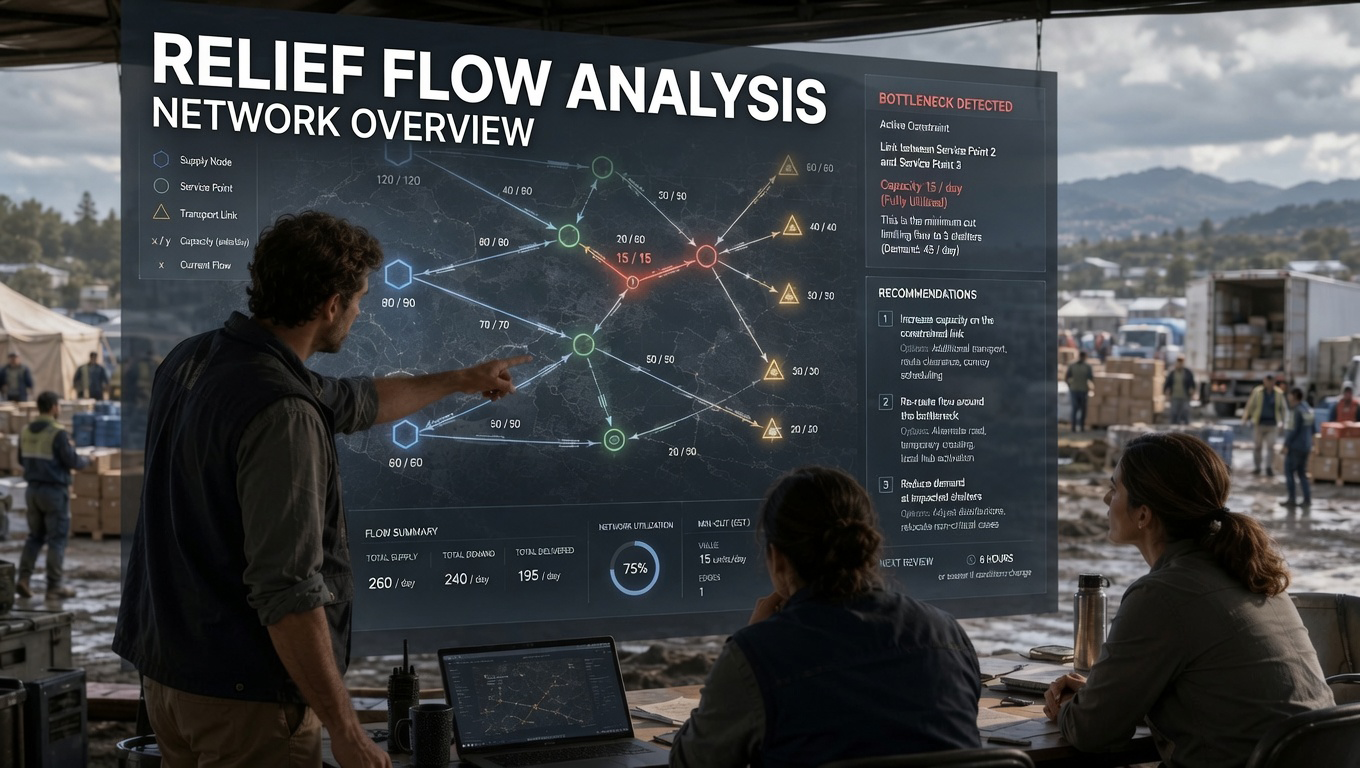
After a disaster, the most visible problem is not always the operational constraint that is actually slowing the response.
A community may have caring volunteers, available supplies, shelter capacity, and willing local partners. Yet one blocked route, one overloaded intake point, one transportation delay, one communications breakdown, or one missing handoff between organizations can become the constraint that limits the entire relief effort.
For families waiting for help, that constraint may be invisible.
Its effect, however, can be immediate and compounding.
This article presents a conceptual framework for internally governed decision-support tools that could help authorized leaders identify emerging operational constraints earlier—drawing on network-flow mathematics, compact pattern recognition, and transparent Zero-Training AI™ prioritization—while preserving human accountability for every consequential decision.
This is not a proposal to outsource decision-making, deploy unapproved third-party models, automate assistance determinations, or replace the judgment of experienced staff and volunteers. It is a concept for internally governed decision support, subject to Information Security, Privacy, Legal, Operations, Architecture, Accessibility, testing, source-code review, and business-owner governance.
Any future prototype would operate only within approved technology environments, use only approved data sources, and keep qualified people responsible for every consequential operational decision.
Disaster Response as a Network-Flow Problem
Humanitarian operations can be viewed as a flow network.
Nodes may represent physical or organizational points such as shelters, distribution sites, intake teams, call centers, warehouses, transportation assets, local partners, or communications channels.
Edges represent the pathways through which people, supplies, information, transportation services, and relief actions move between those points.
In network-flow theory, the amount of useful relief that can move from available resources to people in need is constrained by the network’s minimum cut.
A minimum cut is not necessarily one single bottleneck. It can be a set of routes, service points, handoffs, or capacity limits that together restrict overall throughput.
More formally:
Maximum Relief Flow = Minimum Cut Capacity
Or, in graph terms:
max Flow(s,t) = min Σ Capacity(u,v)
Where:
- s represents the source of available resources or response capability
- t represents the people, locations, or needs requiring assistance
- Flow(s,t) represents the total relief reaching the destination
- Capacity(u,v) represents the safe throughput of a route, team, communication channel, or operational connection
- The minimum cut represents the combination of constraints that most limits overall flow
The practical question for leaders is therefore:
Which constraint is currently limiting the next unit of help from reaching the next person who needs it?
A simplified operational formulation is:
Maximize:
Total Relief Flow = Σ Flow(i,j)
Subject to:
- Flow(i,j) <= Capacity(i,j) for every route, team, or connection
- Total flow into any node <= processing capacity of that node
- Conservation of flow at intermediate nodes
- Safety, policy, accessibility, and operational limits remain satisfied
The mathematics matters because it explains something that is often counterintuitive:
Adding more resources is most valuable when it relieves the active constraint or creates a feasible path around it.
Adding volunteers, supplies, vehicles, or funding elsewhere may have limited effect until the actual bottleneck is addressed.
Why Totals Can Mislead
It is natural to look at aggregate numbers:
- Total volunteers available
- Total supplies on hand
- Total shelter beds
- Total vehicles
- Total available funding
- Total partner organizations
Those totals may be reassuring, but they can also be operationally misleading.
A response can appear adequately resourced overall while still producing serious delays because one specific function or connection has become constrained.
The active bottleneck may be:
- A flooded or blocked route
- Intake volume exceeding processing speed
- A shortage of accessible transportation for a specific need
- Limited language or accessibility capacity at a key service point
- Supply staging delays
- Communications overload
- A missing handoff between partners
- A mismatch between where qualified volunteers are and where they can be effectively deployed
Because the network is dynamic, the active constraint can shift over time.
Weather changes. Roads open or close. Demand rises. Volunteers come on or off shift. Supply routes are disrupted. Communications capacity changes.
Earlier visibility into which constraint is becoming active gives leaders more time to respond while options remain open.
Compact Pattern Recognition for Emerging Bottleneck Signals
Not every useful AI capability requires a massive external model.
For narrowly scoped operational monitoring within approved data environments, a compact purpose-built neural network—potentially on the order of one megabyte—could help recognize limited patterns from approved operational signals.
Examples may include:
- Accelerating request volume or service times at specific intake or distribution points
- A growing mismatch between available transportation assets and demand locations
- A supply route, staging area, or partner handoff approaching capacity
- Geographic or time-based clustering of needs that may overload local capacity
- Combinations of weather, infrastructure status, staffing, and demand associated with elevated bottleneck risk in approved historical or simulated operational scenarios
A model of this scope would not direct services, determine eligibility, make safety decisions, or execute actions autonomously.
Its purpose would be narrower:
To identify patterns that may deserve earlier review by qualified people.
A small model does not become safe merely because it is small. Safety comes from its limited purpose, approved inputs, careful testing, monitoring, clear boundaries, and human oversight.
Transparent Prioritization With Zero-Training AI™
Recognizing that pressure may be building is only the first step.
The next question is:
Among competing constraints, which bottleneck should an authorized leader examine first, and what intervention may most improve the flow of help within approved limits?
Zero-Training AI™ may add value here: it is a transparent decision-support approach in which authorized people configure approved objectives, priorities, constraints, safety boundaries, and human-review requirements rather than asking a general-purpose model to infer the decision from broad historical patterns.
A compact pattern-recognition model may identify a narrow bottleneck signal from approved data; Zero-Training AI™ then evaluates which review priorities and feasible options are permitted under those explicit rules and limits.
For example, an internally governed decision-support configuration could consider:
- Response delay
- Unmet need
- Operational risk
- Capacity strain
- Transportation and logistics burden
- Available volunteer and staff capacity
- Supply and shelter constraints
- Accessibility and language-support requirements
- Weather and local operating conditions
- Privacy, policy, and safety boundaries
- Required human-review points
A simplified objective function may be expressed as:
Minimize:
J = w1(Response Delay) + w2(Unmet Need) + w3(Operational Risk) + w4(Capacity Strain) + w5(Travel and Logistics Burden)
Subject to:
- Safe operating capacity at each node and connection
- Transportation and geographic feasibility
- Approved staffing and volunteer requirements
- Accessibility and language-support rules
- Supply and shelter limits
- Privacy and policy boundaries
- Mandatory human review and approval for consequential recommendations
The weights, w1 through w5, are not hidden values discovered by an algorithm.
They represent mission-approved priorities established through appropriate governance.
Because the framework operates through explicit, approved configuration rather than opaque retraining, authorized changes can be evaluated transparently through defined testing, validation, review, and governance processes.
The output is not an automated directive.
It is a structured recommendation that can explain:
- Which operational signal triggered the review
- Which constraints were active
- Which routes, nodes, or handoffs were under pressure
- Which alternatives were considered
- Why one intervention ranked ahead of another
- Which policy, safety, accessibility, privacy, and resource boundaries were preserved
- Which trained person reviewed, modified, approved, or rejected the recommendation
Explainability Is What Separates Decision Support From a Black Box
In high-accountability humanitarian operations, a responsible recommendation must be able to answer straightforward questions:
- What operational signal or network condition triggered the review?
- Which approved data inputs and capacity estimates were used?
- Which route, service point, handoff, or combination of constraints was identified as the emerging bottleneck?
- Which limits prevented greater relief flow?
- What alternatives were evaluated?
- Why was one intervention ranked higher than another?
- Which safety, policy, accessibility, privacy, and governance boundaries were preserved?
- Which trained individual reviewed, modified, approved, or rejected the recommendation—and when?
A system that cannot answer these questions transparently has no legitimate role in operational decision support.
The technology must serve experienced people by sharpening their view of the network.
It must never substitute for their judgment.
The Goal: See the Right Constraint Sooner
The objective is not to turn disaster relief into an optimization exercise or automate humanity.
It is to use rigorous network-flow thinking and carefully governed decision support to identify a hidden or emerging operational constraint before it becomes the reason families wait longer for help.
By combining:
- Network-flow analysis to understand how overall capacity is governed by the active constraint
- Compact pattern recognition to identify rising pressure across routes, service points, and handoffs
- Transparent Zero-Training AI™ to organize review around explicit mission priorities and limits
It may be possible to design tools that help leaders see where the flow of help is beginning to slow—and what can still be reviewed, within approved authorities, before that slowdown becomes a broader crisis.
The most valuable AI in this domain may not be the system that produces the final answer.
It may be the system that helps experienced operational leaders ask the right question sooner:
Where is the flow of help beginning to slow—and what can qualified people safely do about it now?
Governance and Scope Requirements
This is a conceptual discussion of internally governed decision support only.
It is not a proposal to deploy unapproved AI, automate assistance decisions, replace clinical or operational judgment, or make independent decisions affecting client safety.
Any future capability would require review and approval by Information Security, Privacy, Legal, Operations, Disaster Cycle Services, Architecture, Accessibility, and designated business owners before any use of data, operational testing, or deployment.
It would also require scenario-based validation, appropriate fairness and bias assessment, documented human accountability, ongoing monitoring, and clear escalation paths.
The purpose is to encourage thoughtful internal discussion about how transparent, carefully governed AI may help the recognize operational constraints earlier—so experienced people can respond with more time, more context, and more options.